The large rectangular space is dominated by an altar located against the rear wall. The altarpiece, painted by Sante Piatti in 1728, depicts the Madonna del Carmelo: the Virgin, seated amongst the clouds, holds the Child, who stands and gives his blessing, whilst a little angel proffers a scapular. On either side of the altar, two large carved wooden busts attributed to Giacomo Piazzetta, painted to resemble marble, depict Saint Simon Stock and the Virgin, the focal point of Carmelite devotion.
The altar itself is set within a shallow niche, framed by a large architectural structure. This is repeated along the left-hand side of the chapel, where the two flights of the Grand Staircase are flanked by a pair of portals connected at the centre by a niche, topped with a keystone featuring a female mask and surmounted by a garland. On either side, two further portals, lower and with architraves, lead to two passageways connecting the room to external exits and internal entrances.
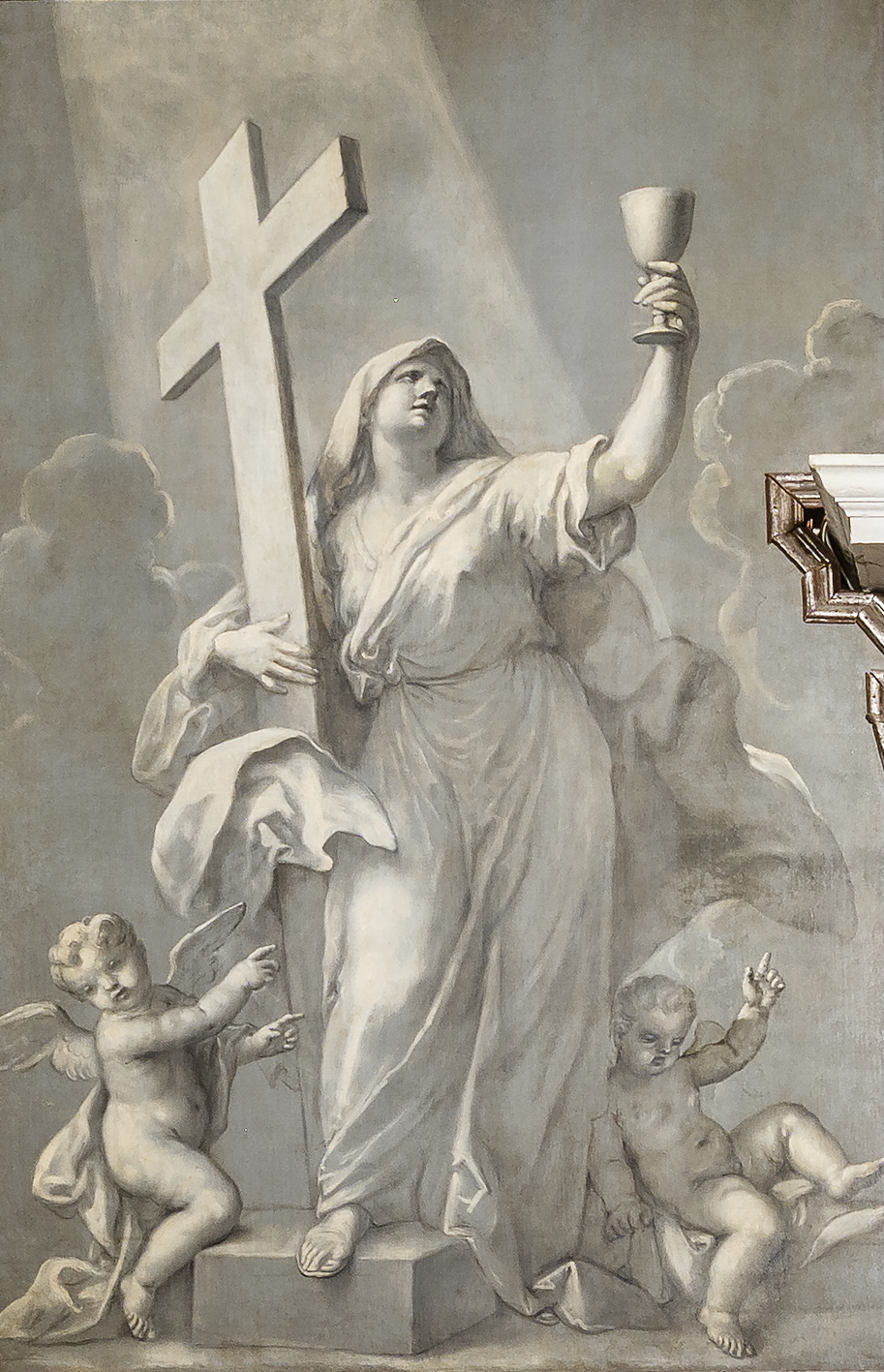
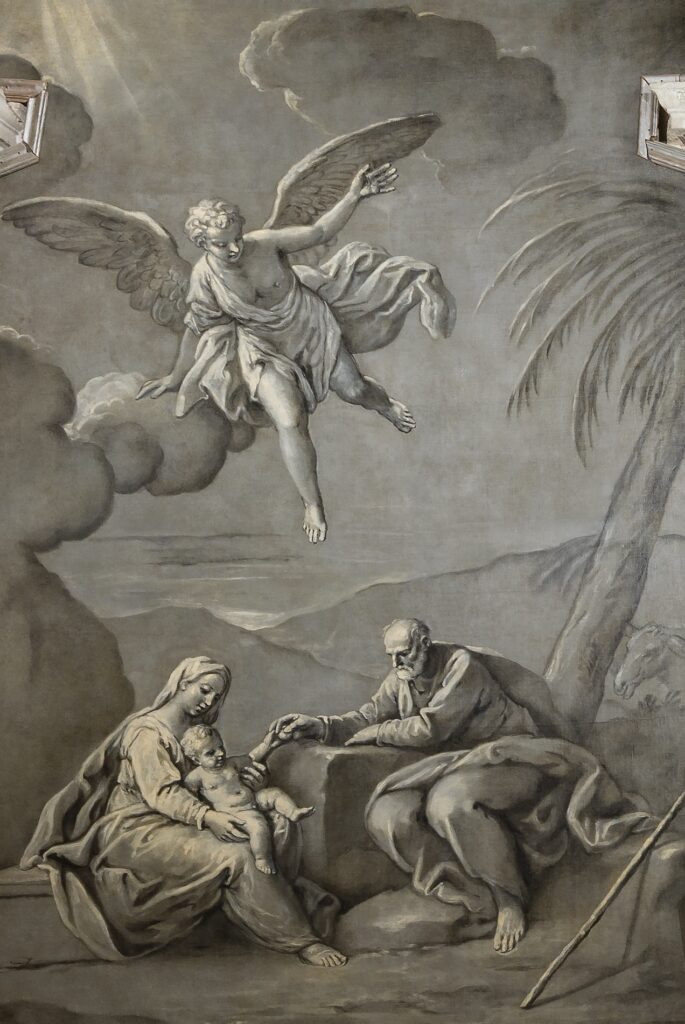
Above the wooden perimeter panels, the walls are adorned with a series of large monochrome canvases in shades of grey, painted by Nicolò and Giovanni Bambini between 1728 and 1739. This grisaille cycle depicts episodes from the life of the Virgin and the childhood of Christ and is unique within eighteenth-century Venetian painting. On the counter-façade, the Annunciation is shown in two paintings placed on either side of the main door, above which God the Father stands out.
Moving clockwise, the first large canvas depicts the Circumcision. Beside it, in three separate canvases placed on either side and above the lintel of the entrance portals to the Grand Staircase, are depicted the Theological Virtues: Faith, with a cross and chalice; Hope, accompanied by cherubs, one of whom holds an anchor, her traditional attribute; and Charity, with one child in her arms and another held by the hand. The fourth canvas depicts a Flying Angel, with the scapular. On the opposite wall, the cycle continues with The Rest on the Flight into Egypt and, towards the main entrance, the Assumption. The decoration is completed by a series of smaller paintings, featuring figures and angelic heads.