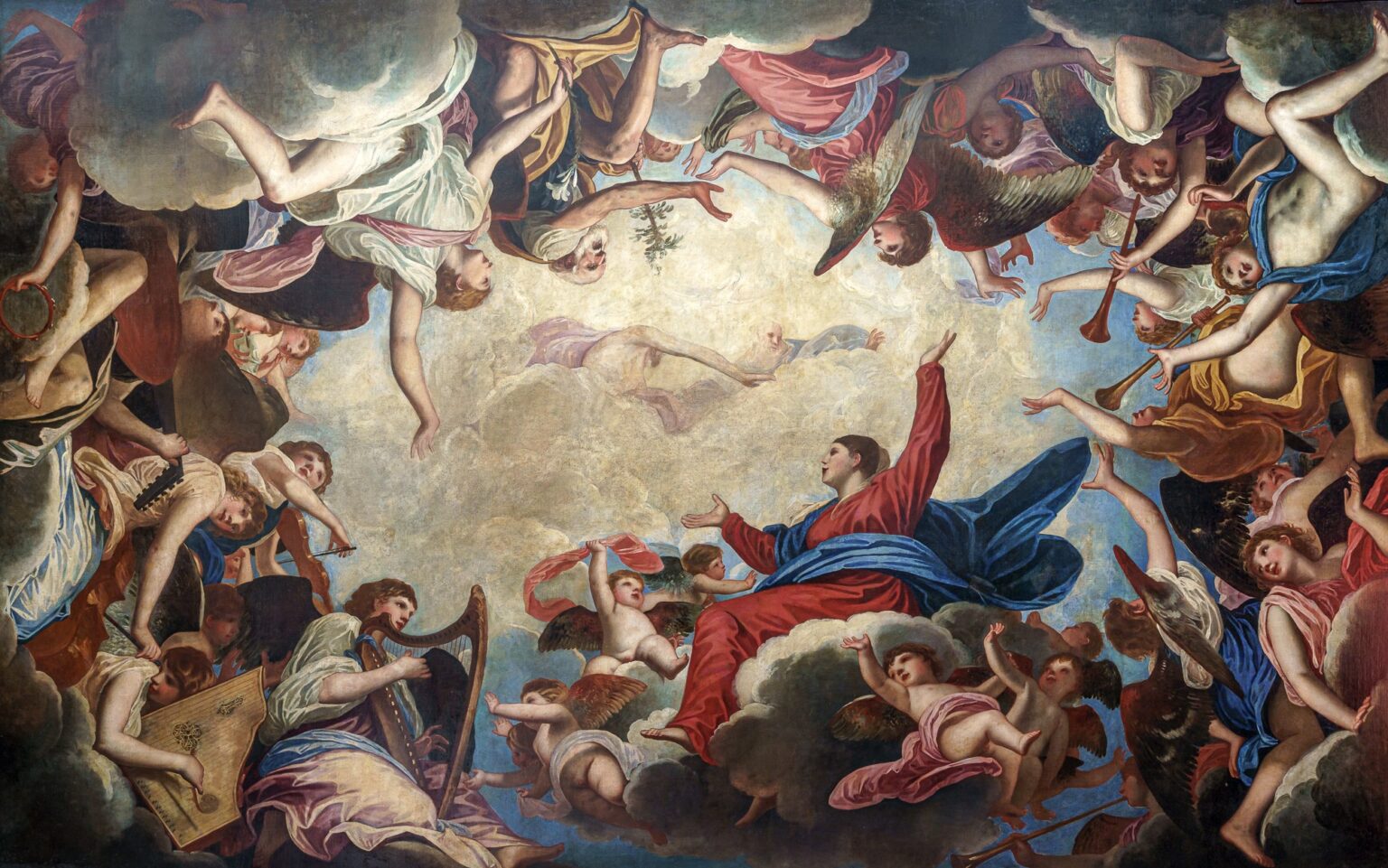
The main decorative element in the room, which was once used for meetings of the Scuola’s governing body, is the majestic canvas in the centre of the ceiling, transferred here from the Sala Capitolare: the Assumption of the Virgin by Padovanino.
Realised between 1635 and 1638, the picture depicts the Virgin Mary seated to the right on a throne of clouds, surrounded by winged cherubs and angels playing music. The latter, distributed along the edges of the composition, leave a large oval of sky free in the central area, creating an evocative open background. On the opposite side to the Virgin we see the figure of a bearded old man holding an olive branch: this is the prophet Elijah, linked to the Carmelite Order.
Also on the ceiling, which remains unfinished as regards its gilding, eight oval spaces around the central painting contain canvases by Menescardi based on a thematic programme by Gaetano Zompini. The Evangelists are depicted in the centre of the four sides, accompanied by their traditional symbols. In the corners, on the other hand, there are the great Prophets, who are linked to the genealogy (David) and theological privileges of the Virgin: Isaiah, Jeremiah and Ezekiel.
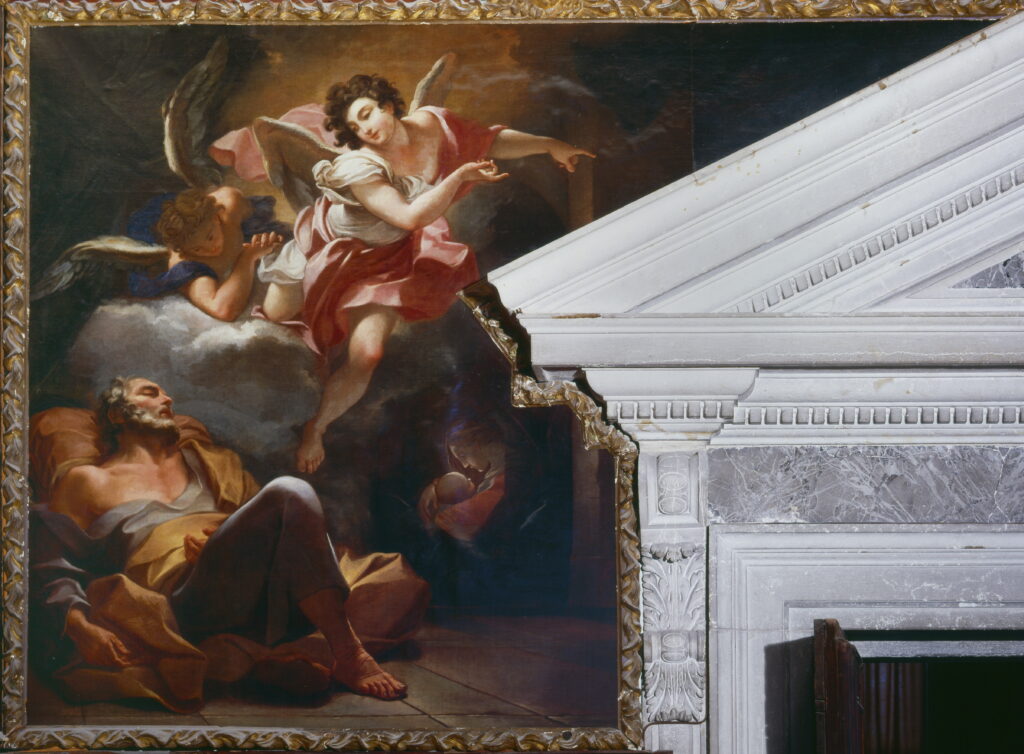
The paintings on the walls mostly depict episodes from the Gospels or from apocryphal texts. Among these are Ambrogio Bon’s Adoration of the Shepherds, painted in 1697 and located above the panelling on the wall facing the Sala dell’Archivio, and two canvases covering the entire wall facing the Sala Capitolare, painted by Antonio Balestra in 1703. To the left of the portal, Joseph’s Dream shows the sleeping Joseph in the foreground receiving a visit from the angel, who tells him that the child Mary is carrying is the Messiah, while in the background, in the shadows, the Virgin Mary can be seen cradling Jesus. To the right of the portal, The Rest on the Flight into Egypt shows the Holy Family gathered on the left of the composition and accompanied by a host of angels.
The room also houses the large banner of the Scuola and four display cases containing sacred and secular objects relating to the life of the confraternity.