The Scuola Building
The choice of project
The building’s design was approved in 1627, with preference given to the proposal submitted by Francesco Caustello, proto of the Procurators of San Marco de Citra. Although his design corresponded in its general layout to that of the current building, it did not yet fully match its present appearance, as the ‘Alle Tre Frecce’ pharmacy stood on the corner of Campo Santa Margherita and Campo dei Carmini. The building was flanked on two sides by the Scuola, which therefore had an inverted ‘L’-shaped plan.
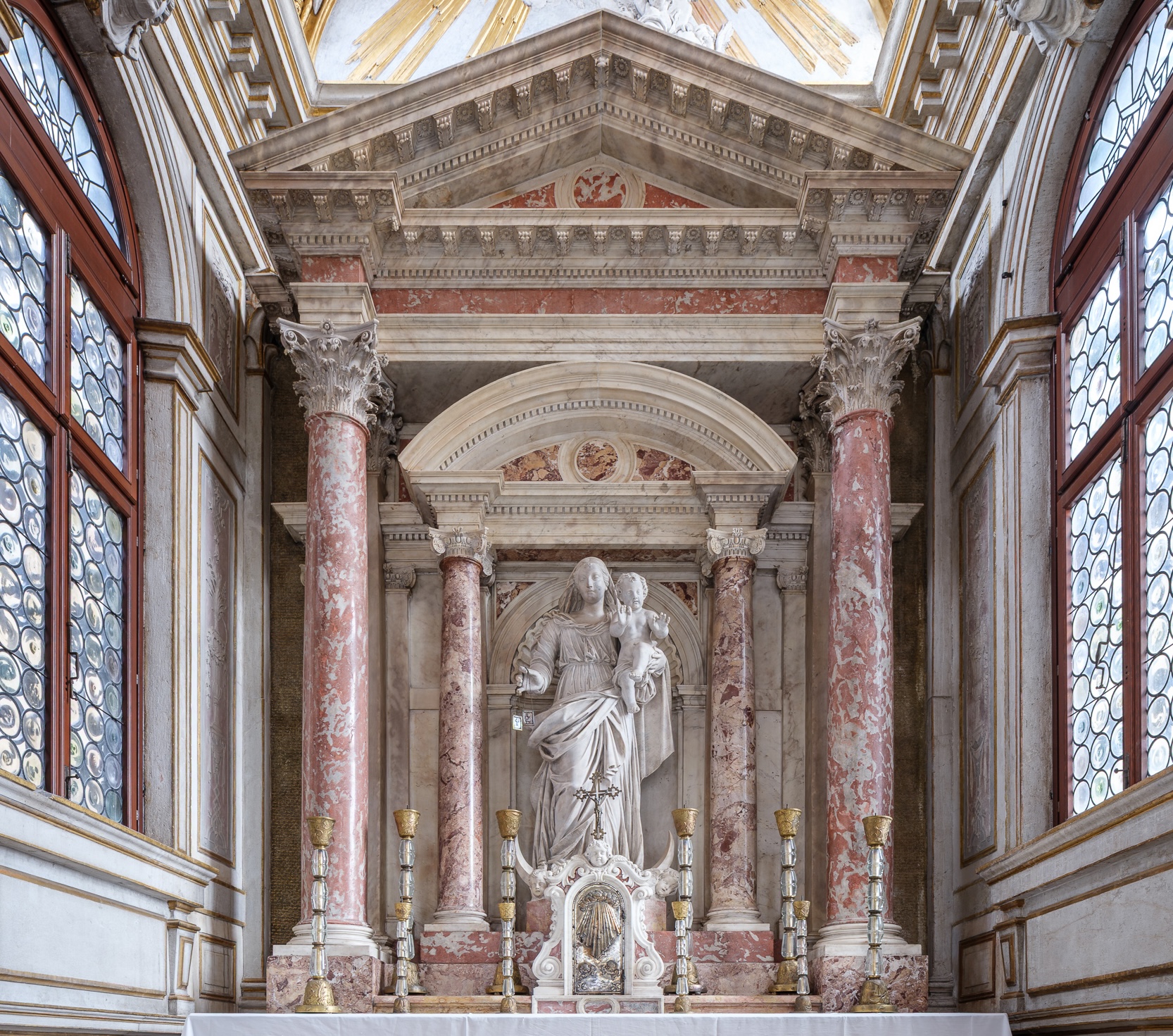
Construction of the Scuola took about fifty years as it was slowed down by numerous obstacles, including lengthy legal disputes with the Guoro heirs. The greatest impediment of all, however, was the plague epidemic of 1630, which led to the total suspension of work. This resumed only at the end of that year, resulting in the building with the rectangular layout we see today, which is in keeping with the typical structure of Venetian Scuole. The inauguration took place in October 1638. The completed parts were the Chapel, the Chapter House and the Archive.
In 1668, the Scuola finally managed to purchase the pharmacy building. The completion works, financed in part by a generous bequest from the nobleman Barbaro Badoer, began the following year under the direction of the seventy-year-old Baldassare Longhena. The work was finally completed in 1670.
The monumental façade
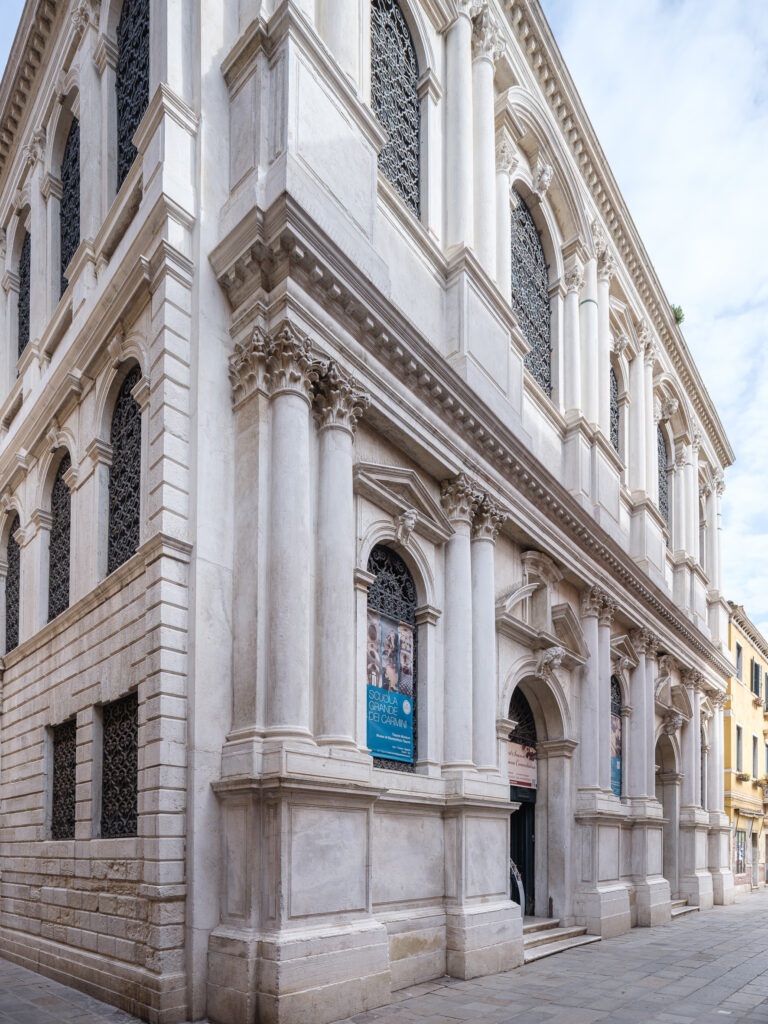
The main façade overlooks the south-western edge of Campo Santa Margherita. Presenting a strongly foreshortened perspective and compressed within the limited space in front of it, it extends over two storeys. The architectural layout, designed to create a symmetrical whole, does not precisely reflect the internal arrangement of the rooms: the three openings on the right-hand side of the two storeys correspond to the Chapel and the Sala Capitolare – the Chapter House – completed in 1638, whilst the two openings on the left-hand side belong to the second phase of construction, begun after the acquisition of the pharmacy.
On the ground floor, raised by three steps, there are two monumental portals, decorated at the top of the arch with angel masks and surmounted by broken pediments enclosing niches that are now empty. Between the two entrances there are three arched windows, similarly adorned with female masks and surmounted by triangular pediments. The upper floor follows the same compositional layout, with a symmetrical arrangement of the windows.
The side façade
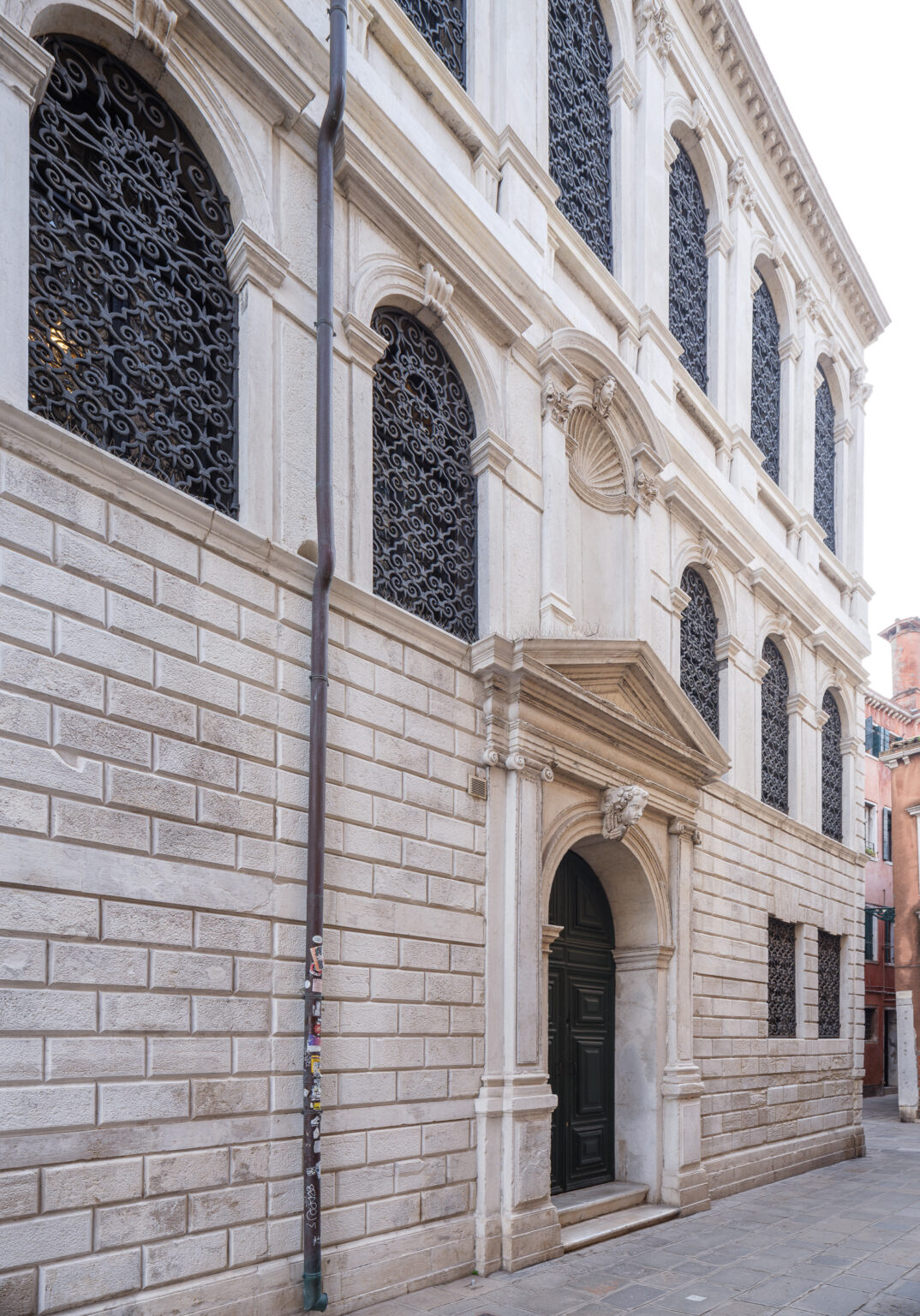
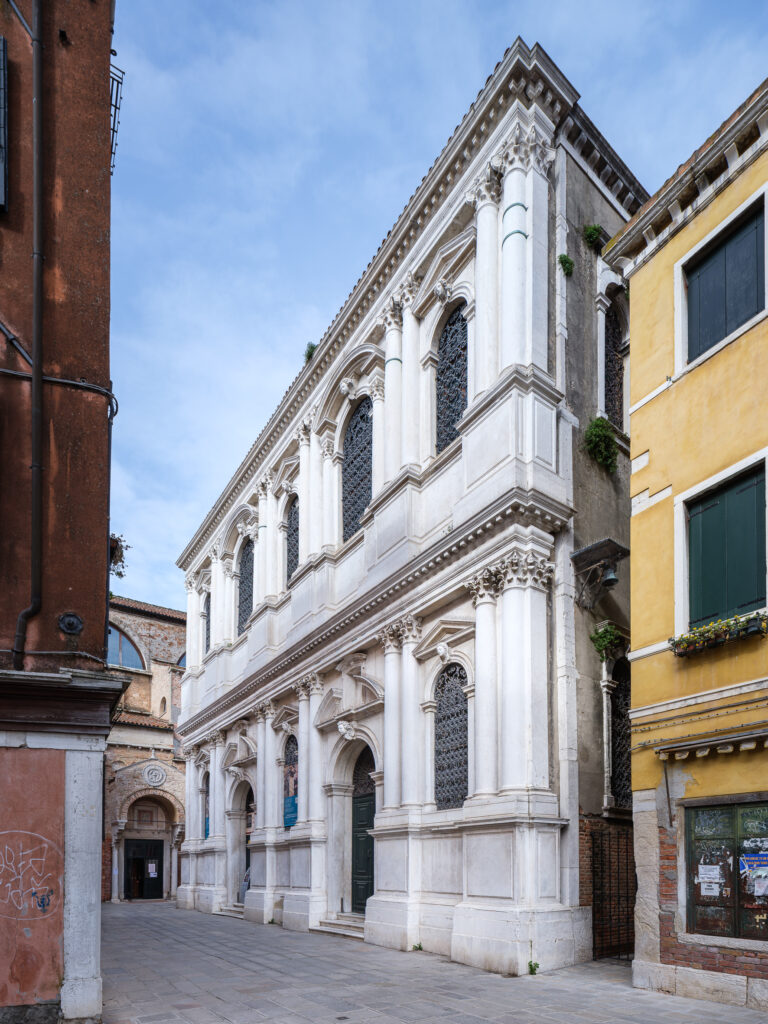
The side façade, running parallel to the left aisle of the church and visible from Campo dei Carmini, is slightly lower than the main façade and is divided into three levels, more faithfully reflecting the internal layout of the building. On the ground floor, characterised by a smooth rusticated façade, there are two arched portals, each with an angel mask in the keystone, flanked by four small quadrangular windows.
The first floor is marked by a series of eight arched windows, interrupted at the portals by false niches with conch-shaped basins and female masks, whilst the second floor features a sequence of ten arched windows, separated by Corinthian half-pilasters.